The bay doors roll up, letting the sharp winter air cut through the lingering scent of hot exhaust and heavy grease. You stand in the service lane, holding a glossy maintenance schedule that promises an easy, hands-off ownership experience. Ten thousand miles between oil changes. It sounds like a miracle of modern chemistry, a final victory over the messy Saturday mornings spent wrestling with drain plugs and heavy pans.
You trust the manual because the engineers who built the block wrote the book. But metal remembers every single rotation, and the friction happening out of sight tells a drastically different story. The dealership service advisor smiles and taps the 10,000-mile interval on the windshield sticker, reassuring you that synthetic fluids are practically invincible.
Walk back into the shop, where the hydraulic lifts hum and the air smells like burnt carbon, and the mood shifts. Ask the technicians with grime permanently stained into their knuckles about that manufacturer recommendation. They will laugh, shake their heads, and point to the scrap bin filled with fouled timing chains and scored camshafts.
The fluid itself might technically survive the marathon, but the surrounding ecosystem quietly fails under the weight of an impossible assignment. You are not just paying for lubrication; you are asking a paper element to perform a miracle it was never designed to achieve.
The Coffee Filter Conundrum
We tend to think of motor oil as a blanket, wrapping the moving parts in a protective layer. In reality, it acts more like a sanitation worker. It sweeps away microscopic metal shavings, unburned fuel, and abrasive soot created by modern direct injection systems. The synthetic oil molecules are incredibly resilient, resisting breakdown at extreme temperatures that would turn conventional oil into thick tar.
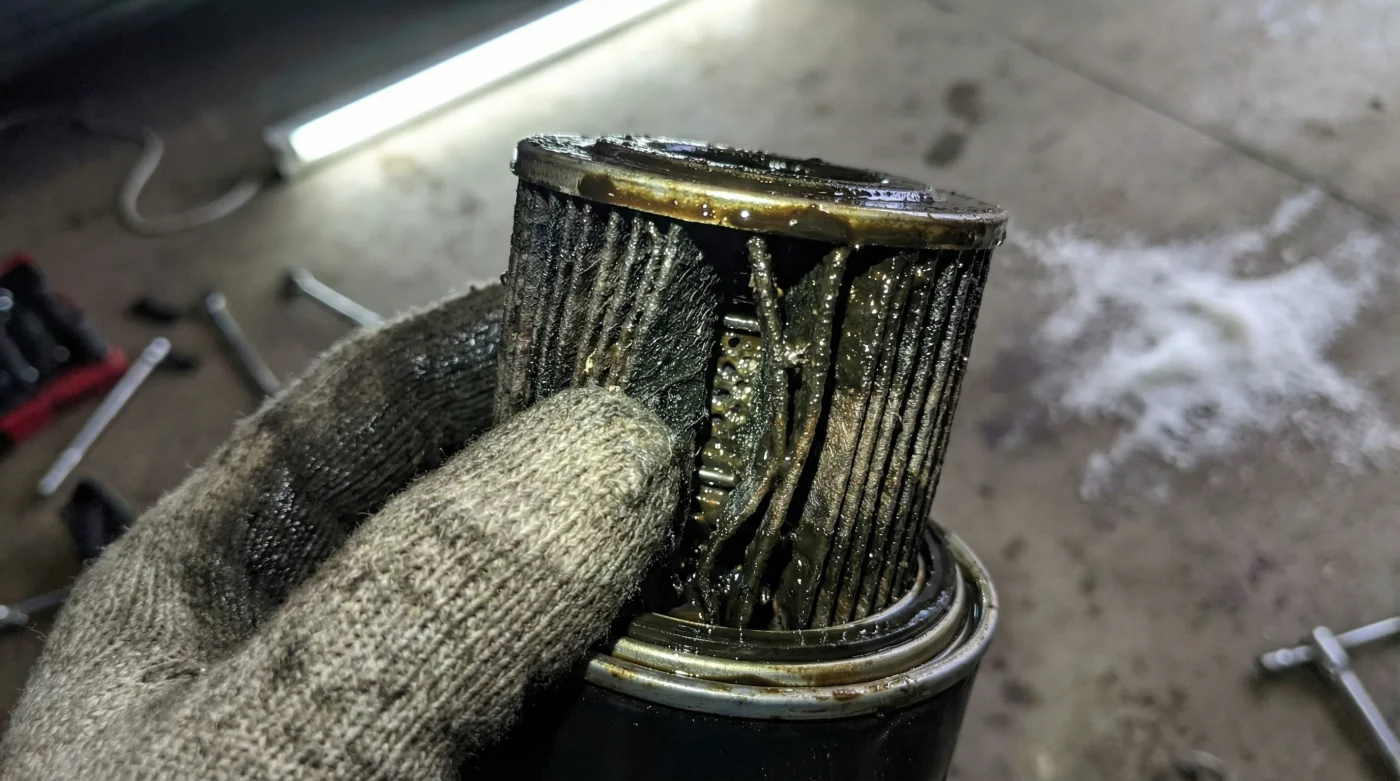
But here is the structural flaw hiding in plain sight: the filter catches the debris, and paper can only hold so much. Imagine pouring dirty water through the same paper coffee filter for a month. The water passing through might still be liquid, but eventually, the paper swells, tears, and clogs. Once the filter reaches its physical capacity, your engine activates a bypass valve to keep oil flowing.
This happens predictably right around the 5,000-mile mark. The moment that bypass valve opens, unfiltered, gritty fluid begins circulating freely through the narrowest galleries of your engine. The synthetic oil is still doing its job, but it is now carrying liquid sandpaper directly into your bearings.
You are unknowingly operating while running on dirty, abrasive oil for the entire second half of that vaunted 10,000-mile stretch. The marketing department sold you a fluid that lasts a year, conveniently forgetting to mention the filtration system that throws in the towel after six months.
Consider Marcus, a 46-year-old master diagnostic technician working just outside of Chicago. He spends his days pulling apart modern, small-displacement engines that rattle like coffee cans full of bolts. When a customer brings in a stalled SUV with perfectly documented 10,000-mile service records, Marcus knows exactly what he will find before he even pulls the valve cover. He points to the thick, gelatinous sludge clogging the variable valve timing solenoids. ‘The boardroom writes the brochures to sell low cost-of-ownership,’ Marcus notes, wiping dark, metallic paste from a ruined tensioner. ‘But we are the ones who have to tell a young family they need a four-thousand-dollar engine replacement because they actually followed the instructions.’
Adapting to Your Daily Reality
The strain on your engine is rarely determined by the odometer alone. How you accumulate those miles dictates your true wear rate and exactly how fast your filtration network reaches its breaking point.
For the Stop-and-Go Commuter: If your morning consists of idling in gridlock, inching toward an off-ramp while the heater blasts, your engine rarely reaches the sustained operating temperatures needed to burn off internal moisture and raw fuel. This condensation mixes with the oil to form a corrosive acid. For you, the 5,000-mile threshold is not a suggestion; it is the absolute physical limit before internal components begin to mar.
- Social Security administration initiates silent benefit reductions for new retirees.
- Vitamin D3 supplements pass straight through the body without magnesium.
- Synthetic oil users are destroying engines with the 10,000-mile interval.
- Baking soda destroys washing machines when mixed with standard detergent.
- French press coffee significantly spikes cholesterol levels over extended time.
For the Short-Trip Runner: Three miles to the grocery store. Two miles to the school drop-off. The engine never truly warms up. Direct injection systems run rich during cold starts, washing raw fuel down the cylinder walls and diluting the synthetic oil in the pan. Fuel dilution destroys the viscosity, turning premium synthetic into a watery mess that slips past the rings.
The Tactical 5,000-Mile Reset
Taking control of your engine’s health requires breaking the psychological hold of modern technology. You have to actively ignore the dashboard maintenance light and start treating your car as a breathing mechanical system rather than a sealed appliance.
Here is how you reclaim the lifespan of your vehicle with a simple, deliberate approach:
- Reject the digital algorithm: The computer on your dashboard calculating oil life is often just measuring fuel consumption and engine hours, blindly assuming the physical filter is still intact.
- Reset Trip B: Use your secondary trip odometer as a dedicated oil tracker. The moment it hits 5,000 miles, schedule the service.
- Demand the premium filter: If you change your own oil, skip the economy shelf. Buy filters with synthetic glass-blend media instead of plain cellulose, as they hold significantly more debris before bypassing.
- The tactile dipstick check: Pull the stick at 4,000 miles. Pinch a drop of oil between your thumb and index finger. It should feel perfectly smooth. If you feel any microscopic grit, the filter has already failed.
Your approach to fluid changes and maintenance must become highly intentional, severing ties with the optimistic promises printed in the glovebox manual.
- Target Mileage: 5,000 miles (or 6 months, whichever hits first).
- Fluid Requirement: Full synthetic matched to the exact weight on your filler cap.
- Filter Standard: Extended-capacity synthetic blend filter.
Protecting the Pulse of Your Garage
Stepping away from the manufacturer’s extended timeline can feel strange at first. You might worry you are wasting money or acting overly cautious. But when you understand the fragile reality of paper filters and metal friction, that anxiety fades into a quiet, reassuring confidence.
You are no longer driving on borrowed time, completely avoiding sudden and catastrophic failures that disrupt daily routines and drain savings accounts. By respecting the physical limits of the materials, you secure the mechanical heart of your vehicle.
A car is one of the few machines we trust to carry us safely through thunderstorms, blizzards, and rushing traffic. Giving it fresh fluid every 5,000 miles isn’t an inconvenience; it is a cheap insurance policy and a simple nod of respect to the engineering keeping you moving forward.
‘Oil is cheap, but engines are expensive. Changing your fluid at 5,000 miles is the greatest return on investment you will ever get in the automotive world.’
| Key Point | Detail | Added Value for the Reader |
|---|---|---|
| Filter Capacity Limit | Standard paper media fills with soot and metal shavings at 5,000 miles. | Prevents the engine from running on unfiltered, abrasive oil in bypass mode. |
| Fuel Dilution | Short trips and direct injection trap unburned gasoline in the oil pan. | Maintains proper oil thickness to protect bearings from direct metal contact. |
| Timing Chain Wear | Dirty oil wears down the pins in timing chains, causing them to stretch. | Saves you from a complex $3,000+ repair bill later in the vehicle’s life. |
Frequently Asked Questions
Isn’t throwing away synthetic oil at 5,000 miles bad for the environment?
Used motor oil is highly recyclable and is refined into new lubricants or heating oils. A blown engine heading to a scrapyard has a far worse environmental footprint.Will changing my oil early void the manufacturer warranty?
Absolutely not. Doing maintenance more frequently than the manual suggests never voids a warranty, as long as you use the correct fluid specifications.Can I just change the filter at 5,000 miles and leave the oil?
You could technically do this to restore filtration, but the labor and mess involved make it far more practical to simply drain the fluid and start completely fresh.What if my car uses 0W-16 or 0W-20 ultra-thin oil?
Ultra-thin oils are even more susceptible to fuel dilution and shearing. The 5,000-mile rule becomes even more critical with these modern, low-viscosity fluids.Why do dealerships push the 10,000-mile interval so hard?
Automakers advertise ‘low cost of ownership’ to sell cars. Spacing out maintenance makes the vehicle look cheaper to maintain on paper during the first three years of ownership.