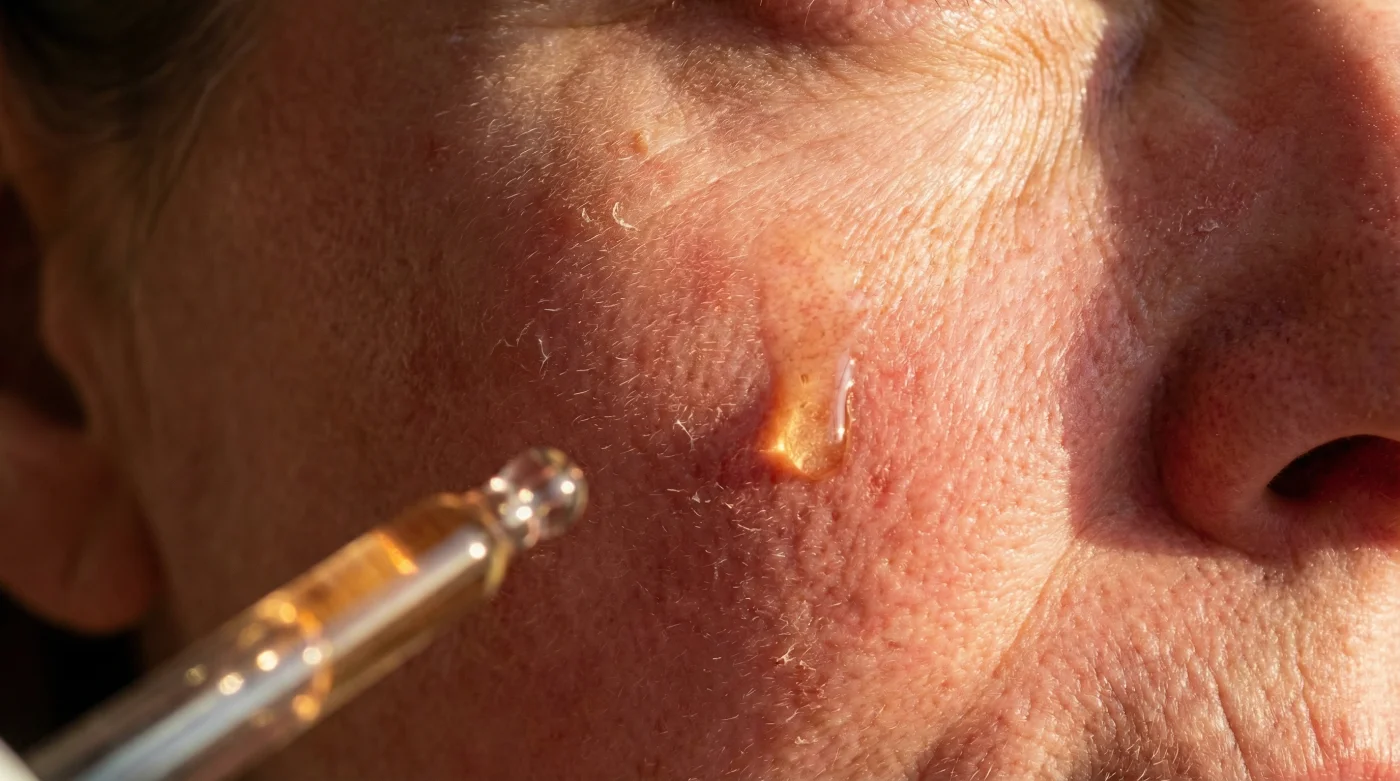
The morning light hits your bathroom mirror, casting a harsh, unforgiving glare on the delicate skin around your eyes and jawline. You reach for that amber glass dropper, unscrewing the cap with a familiar, satisfying click. It feels like taking control. The golden liquid slips over your cheeks, cool and promising, an expensive armor you wear to face a day of oxidative stress and city smog.
You pat the serum in, trusting the active ingredients to smooth the fine lines that seem to multiply after your fiftieth birthday. You apply it religiously, assuming that fighting the clock requires a dawn-to-dusk offensive. If the bottle says it builds collagen, putting it on before your morning coffee just makes logical sense. It is the routine you have known for years, a comforting ritual before the chaos of the day begins.
But as you step out of your front door into the glaring 9 AM sun, an invisible, destructive chemical reaction begins. The very compound you rely on to rebuild your barrier is actively fracturing under UV exposure. Instead of repairing your skin, you are inadvertently holding a magnifying glass over dry leaves.
The Cellular Night Shift
Imagine hiring a crew to completely replace the roof of your house. Now imagine demanding they do the demolition work while a category-three hurricane batters the exposed beams. That is precisely what happens when you introduce retinol to a mature epidermis during daylight hours.
By accelerating cell turnover, the serum aggressively sheds the protective outer layer of dead skin. It removes your natural armor, sending naked, vulnerable new cells straight into a radiation field. The sun does not just deactivate the retinol molecule, rendering your expensive serum completely useless; it actively inflames the raw, newly exposed tissue.
This biological friction is not a manufacturing defect. The extreme photosensitivity of retinoids is actually a biological mandate, forcing you to align your skincare with your body’s circadian rhythm. It is a strict physiological rule: deep repair requires complete darkness. Your cells are designed to divide, heal, and flush out toxins while you sleep. Applying retinol in the morning forces your skin to perform heavy reconstructive surgery while simultaneously trying to fend off environmental attackers.
Dr. Miriam Vance, a 58-year-old dermatological researcher operating a busy clinic in sunny Scottsdale, Arizona, kept seeing the same baffling pattern. Women in their fifties and sixties were coming in with sudden, stubborn hyperpigmentation and paper-thin textures, despite spending hundreds on top-tier retinoids. The Arizona sun was acting as a cruel auditor for their skincare habits.
During her consultations, Miriam realized the exact culprit behind the accelerated aging. They wanted faster, dramatic results, mistakenly believing that a morning application acted like a daily vitamin. They were double-dosing, causing low-grade, chronic inflammation that degraded their collagen reserves far faster than any nighttime routine could ever rebuild them.
Adapting the Routine for Mature Skin
Moving your most powerful active ingredient strictly to the evening requires a slight mental adjustment. We need to break down the approach based on how you prefer to treat your skin.
For the Morning Minimalist
If you crave a simple, one-step liquid to wake up your face, drop the vitamin A derivatives entirely from your morning cabinet. Swap them for a potent L-ascorbic acid (Vitamin C) serum. Vitamin C actually loves the morning. It scavenges the free radicals produced by UV rays and pollution, acting as a true daytime shield while your morning coffee brews.
- Social Security administration initiates silent benefit reductions for new retirees.
- Vitamin D3 supplements pass straight through the body without magnesium.
- Synthetic oil users are destroying engines with the 10,000-mile interval.
- Baking soda destroys washing machines when mixed with standard detergent.
- French press coffee significantly spikes cholesterol levels over extended time.
You might think applying the product twice a day accelerates the firming process. More is just more irritating, stripping the barrier without giving it a chance to rebuild. If you want maximum efficacy without the sun-induced damage, focus on cyclic application in the dark. Give your face a potent dose on Monday night, then spend Tuesday and Wednesday evenings deeply hydrating to let the barrier recover fully.
For the Sensitive Skin Veteran
If your skin already leans dry, red, or reactive—a common shift as estrogen levels drop in your fifties—the thought of an aggressive nighttime application might sound painful. This is where the sandwich method saves you. Apply a thin layer of basic moisturizer first, then your retinol, followed by a heavier cream. It slows the absorption rate down to a gentle, manageable trickle.
Mindful Application and the Midnight Mandate
Executing this shift properly requires deliberate timing. You are no longer rushing through a morning routine; you are setting a nighttime stage. The solution is wonderfully simple: restrict your retinoids strictly to the hours after dusk. Let the darkness do the heavy lifting.
Your body’s natural regenerative processes peak while you are asleep, making midnight the absolute perfect environment for cellular turnover. Your skin needs quiet hours to process the chemical instructions the serum provides.
- Cleanse with milk or oil: Strip away the day’s grime without stripping away your natural lipids. A foaming cleanser is often too harsh before a strong active.
- Wait for total dryness: Damp skin acts like a sponge, pulling the retinol in too fast and causing severe irritation. Wait five full minutes after drying your face.
- The Pea-Sized Rule: Tap a single, pea-sized drop across your forehead, cheeks, and chin. Do not slather it on; it should feel like a whisper, not a blanket.
- Seal it in: Follow up with a thick, ceramide-rich cream to lock moisture in and prevent the dreaded morning flakiness.
To maximize this process, target a room temperature around 68 Fahrenheit for your bedroom to prevent sweating the product off onto your pillowcase. Allow exactly 15 minutes between your retinol application and your final moisturizing cream to ensure the active ingredients have fully settled into the epidermis.
The Bigger Picture
Stepping away from the morning retinol habit requires letting go of the exhausting idea that we have to actively fight our skin at all hours of the day. It is a shift from constant warfare to strategic restoration.
Aging gracefully requires permission to rest. When you stop forcing vulnerable cells to battle the harsh midday sun, you actually allow the ingredients you paid for to finally do their job in peace. It brings a profound calm to your morning routine, knowing that all you have to do is protect and hydrate. Your skin has already done the difficult, transformative work in the quiet safety of the night.
“The skin is a brilliant self-healer, but forcing it to regenerate while under the assault of daylight is like trying to plant a garden in the middle of a freeway.”
| Key Point | Detail | Added Value for the Reader |
|---|---|---|
| UV Degradation | Sunlight breaks the chemical bonds of retinoid molecules. | Saves you money by ensuring your expensive serums actually remain active. |
| Photosensitivity | New, exposed cells burn and inflame easily under daylight. | Prevents the hyperpigmentation and sunspots that age mature skin faster. |
| Circadian Repair | Cellular turnover naturally peaks during midnight sleep cycles. | Aligns your routine with biology, maximizing firming results with less effort. |
Frequently Asked Questions
Does sunscreen completely protect me if I use retinol in the morning?
No. While SPF prevents sunburn, it does not stop the chemical degradation of the retinol molecule itself caused by ambient daylight and heat. You are still wasting the product.If I wash my face in the morning, is my skin still sensitive from the night before?
Yes, the skin is inherently more sensitive because the retinol has accelerated the shedding of dead cells. However, washing your face prepares a clean, safe slate for your daytime SPF protection.Can I use a lower percentage retinol during the day?
It is highly discouraged. Even low concentrations undergo the same chemical fracturing when exposed to UV light, leading to invisible inflammation and wasted money.What if I work night shifts and sleep during the day?
Your routine should follow your sleep cycle. Apply the retinol before your longest period of sleep, ensuring your bedroom is equipped with blackout curtains to simulate deep night.How long does it take for the morning redness to stop once I switch to night-only?
Most mature skin barriers take about two to three weeks to stabilize once the daytime inflammatory trigger is removed and nighttime hydration is prioritized.