The low, steady hum of an autumn rainstorm washing over your gutters is supposed to be a comforting sound. You sit in your living room, insulated from the damp chill, trusting that the physical barrier keeping your family dry is fully protected by the monthly premium you automatically pay. It feels like a silent, unbreakable pact between you and your insurance provider.
Yet, if you were to spread those policy documents across your kitchen table, you might find that your comfort is built on a misunderstanding. Your financial safety net shrinks quietly in the background while you go about your daily routine. The security you feel is often tied to an assumed reality that simply does not exist in the fine print.
We are taught to view insurance as an absolute shield. The contract exists in a binary state in our minds: either the storm damage is covered, or it isn’t. We rarely consider the complex math happening behind the scenes, dictating exactly how much of that damage is actually our own responsibility.
The roofing industry, however, operates on a sliding scale of degradation. The stark reality is that standard coverage secretly prorates older materials sitting above your head, turning a twenty-thousand-dollar repair into an unexpected out-of-pocket crisis when you least expect it.
The Perspective Shift
Think of your roof the same way you think about a bruised apple left on the counter. It isn’t a permanent fixture; it is organic, degrading slowly under the relentless friction of UV rays, freeze-thaw cycles, and heavy winds. Every single day, microscopic granules wash away into your gutters, taking pennies of value with them.
When you read the word ‘covered’ in your State Farm policy, your brain naturally imagines a contractor tearing off the old materials and installing brand new ones at no cost to you. This dangerous illusion leaves families scrambling for personal loans after a severe weather event rips through their neighborhood.
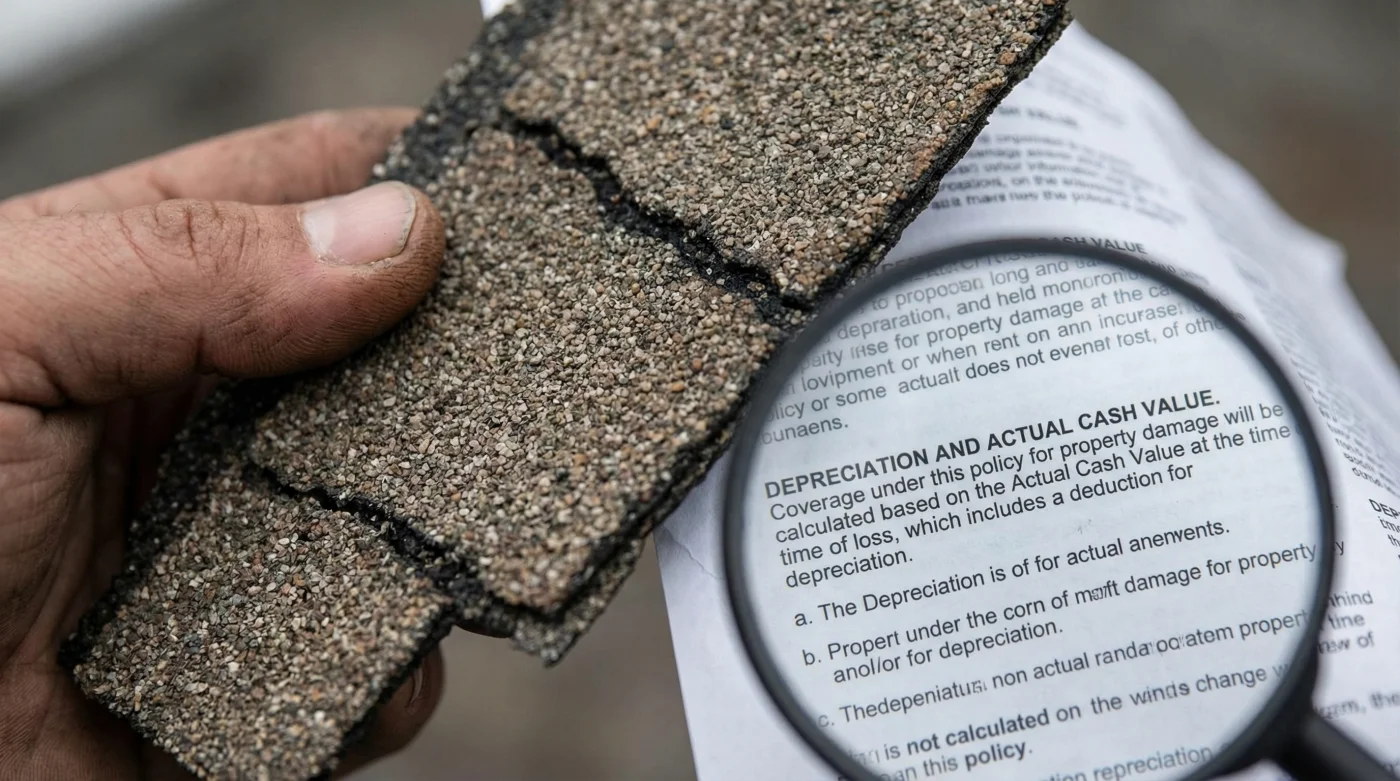
The pivot happens when you stop looking at your insurance as a guarantee of replacement and start viewing it as a highly specific financial ledger. The industry standard defaults to a concept called Actual Cash Value (ACV) for older roofs, meaning they only pay out what your aging shingles are mathematically worth today, not what it costs to buy new ones tomorrow.
A ten-year-old architectural shingle doesn’t carry the same value as a fresh one. You must spot the clause that dictates this rapid depreciation before the next front rolls through your county, or you will be left paying the difference.
Marcus Thorne, a 44-year-old independent claims adjuster based in storm-heavy Oklahoma, spends his afternoons standing on steep pitches, chalking hail hits. He frequently sits across from homeowners who are paralyzed by the gap between their insurance payout and their roofer’s estimate. ‘People assume a roof is a static asset,’ Marcus says, wiping shingle grit from his hands. ‘But insurers see a roof past its tenth birthday as a depreciating liability. If you haven’t explicitly bought Replacement Cost Value coverage, you’re going to get a check for a fraction of the repair, and the realization hits these folks like a second storm.’
Marcus’s warning cuts through the dense legal jargon that normally puts homeowners to sleep. The fine print dictates everything, and ignoring it means you are functionally self-insuring a massive portion of your property without even realizing it.
Deep Segmentation: How Age Changes Your Risk
For the Recent Homebuyer
You just closed on a house with a roof that is supposedly ‘in good condition’ according to the home inspector. The sellers might have even touted the roof’s seven-year age as a prime selling feature, giving you a false sense of security.
At this stage, you might falsely assume your newly bound policy treats that roof as a fresh start. Your risk is highly deceptive because the depreciation clock started ticking long before you ever picked up the keys to the front door.
For the Tenured Homeowner
You have watched your kids grow up under this roof. You have cleared the gutters for a dozen autumns. The roof has never leaked, so you assume your policy remains exactly as robust as the day you first signed the paperwork.
Unfortunately, many carriers automatically shift your coverage from Replacement Cost to Actual Cash Value once the materials cross the ten or fifteen-year threshold. Your policy silently downgraded itself without requiring a new signature or sending a blaring alert to your phone.
Mindful Application: Auditing Your True Coverage
The fix does not require an advanced degree in contract law or hours spent arguing on the phone with a call center. It requires ten minutes of quiet focus and a willingness to verify the exact words written on the paper.
- Social Security administration initiates silent benefit reductions for new retirees.
- Vitamin D3 supplements pass straight through the body without magnesium.
- Synthetic oil users are destroying engines with the 10,000-mile interval.
- Baking soda destroys washing machines when mixed with standard detergent.
- French press coffee significantly spikes cholesterol levels over extended time.
You are looking for the ‘Loss Settlement’ provision. In a standard State Farm HO-3 policy booklet, navigate directly to Page 12 or 13, buried under Section I – Conditions. Here is your tactical toolkit for verifying the math.
- Locate the Declaration Page: Look for the specific line item labeled ‘Roof Surface.’
- Find the Acronyms: Search for RCV (Replacement Cost Value) versus ACV (Actual Cash Value).
- Check the Age Threshold: Read the endorsements to see if an automatic ACV schedule triggers when your roof turns 10, 15, or 20 years old.
- Request the Endorsement: If you see ACV, immediately contact your agent to price out an RCV endorsement for your home.
Knowing precisely where you stand allows you to breathe easier when the weather turns violent. You stop blindly trusting paper and start managing your actual household exposure with total clarity.
The Bigger Picture: Owning Your Peace of Mind
Finding this hidden roof replacement clause isn’t just about outsmarting an insurance carrier or saving a few thousand dollars down the line. It is about fundamentally changing your relationship with your home’s upkeep and financial vulnerability.
When you know exactly how your shelter is valued, you strip away the anxiety of the unknown. You take back the power, shifting from a passive consumer hoping for the best to an informed steward of your property.
Next time the sky darkens and the heavy rain begins drumming against the ceiling, you won’t have to wonder if your coverage is a sturdy shield or a leaky bucket. You will know.
Insurance is not a shield; it is a financial ledger that requires constant audits.
| Key Point | Detail | Added Value for the Reader |
|---|---|---|
| Actual Cash Value (ACV) | Pays only the depreciated worth of your older roof. | Helps you recognize immediate financial gaps. |
| Replacement Cost Value (RCV) | Pays to install a brand new roof at today’s market rates. | Secures your out-of-pocket expenses during a crisis. |
| Loss Settlement Provision | Located around Page 12 of a standard HO-3 policy. | Saves you hours of skimming legal jargon. |
Frequently Asked Questions
Does State Farm automatically downgrade my roof coverage?
Many standard policies contain an endorsement that shifts coverage to Actual Cash Value once the roof reaches a specific age, often 10 to 15 years.
Where do I find the replacement cost clause?
Check your policy declarations page under ‘Roof Surface’ and review the ‘Loss Settlement’ provision, typically found near Page 12 of your standard HO-3 booklet.
Can I upgrade back to Replacement Cost Value?
Yes, in most cases, you can contact your agent to add an RCV endorsement, though it will slightly increase your monthly premium.
What is the depreciation cliff?
It is the point in your roof’s lifespan where insurers drastically reduce its assessed value, leaving you responsible for the bulk of replacement costs.
Do other insurance carriers use this same tactic?
Yes, prorating aging roof materials is an industry standard across most major carriers, making this audit vital regardless of your provider.