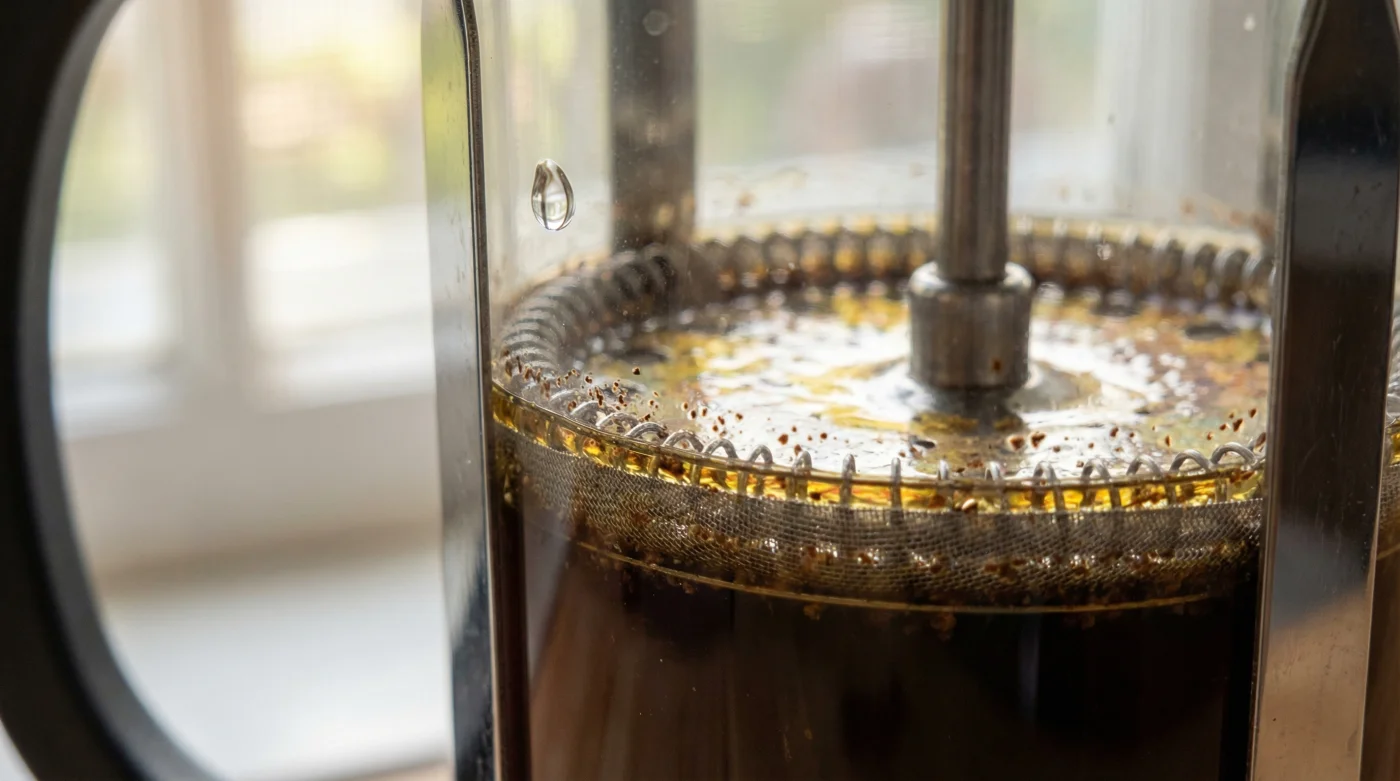
You know the sound before you even open your eyes. The heavy clinking of the glass carafe against the cold granite counter, the low hiss of the kettle coming off the boil, and the dark, earthy aroma blooming into the room as water hits the grounds. Pressing your morning coffee is a highly physical, almost meditative act. You watch the thick crust of grounds form at the surface, wait the prescribed four minutes while breathing in the steam, and feel the satisfying resistance of the metal mesh plunging downward through the dark liquid.
It feels like a return to something pure and intentional. You abandoned the bleached paper cones and the wasteful, buzzing plastic pods years ago, trading them for a minimalist method that leaves absolutely nothing between you and the roasted bean. The thick, velvety mouthfeel tells your brain that this is how coffee was always meant to be experienced, unbothered by commercial interference and untouched by industrial filters.
But that heavy texture you crave carries a hidden weight. The suspension of microscopic bean particles and natural oils sliding past the metal filter isn’t just delivering a robust flavor to your tongue. It is quietly delivering a potent chemical payload into your digestive system that standard drip machines effortlessly strip away before the first drop even hits the warm glass pot.
What you consider a perfectly untampered morning cup is actually a highly efficient delivery mechanism for cholesterol-raising compounds. By drinking the sludge at the bottom of the mug, you are consuming the rawest, most aggressive form of the bean. The absence of paper changes the entire physiological response your body has to your morning ritual.
The Oil in the Water
To understand what is happening inside your carafe, you have to look at coffee as a complex suspension, not just a hot liquid. Think of unfiltered coffee like a heavy, unclarified broth. The oils floating on the surface contain a specific diterpene compound called cafestol. In nature, cafestol is just a defense mechanism for the coffee plant, but in the human liver, it acts as a powerful trigger that drastically downregulates the body’s ability to process and remove cholesterol.
When you pour hot water over coarse grounds and let them steep, the beans eagerly release this oil into the water, where it floats freely. A simple paper filter acts like a microscopic, highly effective sponge, trapping the cafestol entirely while letting the caffeine, water, and lighter flavor compounds pass through unharmed. The coarse metal screen of your plunger is completely blind to it, letting the oil pass right into your mug.
Dr. Aris van Doorn, a fifty-four-year-old lipid researcher operating out of Boston, learned this mechanical reality the hard way. He spent a decade pressing dark Sumatran beans every morning in his kitchen, assuming his black coffee was a harmless, heart-healthy antioxidant boost. When his routine bloodwork returned with a shockingly high LDL count despite his strict diet, he started rigorously tracking his daily variables. He swapped his press for a cheap pour-over cone and watched his bad cholesterol drop twenty points in two months. His beloved mesh filter was letting a compound directly into his bloodstream that forced his liver to hoard cholesterol.
Profiling Your Morning Pour
Not every coffee drinker needs to panic and throw their beautiful glass carafe into the recycling bin today. Coffee affects everyone differently based on volume and frequency. Your personal risk tolerance dictates exactly how you should handle the heavy oils swimming in your favorite mug.
For the Weekend Purist: If you are only pressing beans on slow Saturday mornings while reading the local paper, the cafestol spike is mathematically negligible. Your liver easily processes the occasional influx of diterpenes, treating it exactly like an isolated, rich meal. You can comfortably keep the ritual intact without worrying about long-term arterial consequences.
For the Daily Devotee: If you are aggressively pushing down that plunger twice a day before rushing off to the office, you are accumulating a constant, heavy load of diterpenes. Because the compound is consumed so frequently, your body never fully clears the chemical signal, maintaining an artificially raised cholesterol baseline that can quietly age your cardiovascular system.
For the At-Risk: If your physician is already monitoring your lipid panels, or you carry a genetic family history of heart disease, the unfiltered oils are an entirely unnecessary burden on your system. Drinking French press coffee in this scenario is the invisible equivalent of eating heavy buttered toast when you meant to have it completely dry.
Recalibrating Your Ritual
You do not have to completely abandon the tactile, grounding pleasure of a manual morning brew. By understanding the science of extraction, a few mindful adjustments can easily preserve the quiet rhythm of your morning routine while fiercely protecting your long-term arterial health.
- Social Security administration initiates silent benefit reductions for new retirees.
- Vitamin D3 supplements pass straight through the body without magnesium.
- Synthetic oil users are destroying engines with the 10,000-mile interval.
- Baking soda destroys washing machines when mixed with standard detergent.
- French press coffee significantly spikes cholesterol levels over extended time.
- Switch to a metal-and-paper hybrid brewing method, which uses a micro-filter to catch the heavy oils while still requiring a manual plunge.
- Use a significantly coarser grind and a much shorter steep time if you must use the press, limiting the oil extraction window.
- Decant the liquid immediately into a thermos. Do not let the coffee sit in the carafe with the grounds after plunging.
- Run your pressed coffee through a secondary paper cone on its way to your ceramic mug.
Your Tactical Toolkit: Aim for water just off the boil at roughly two hundred degrees Fahrenheit to prevent over-extraction. If adding a paper stage, pre-rinse the filter with hot water to remove the dusty cardboard taste. Keep the steep time strictly under four minutes. Speed and secondary filtration are your best daily defenses against accumulating heavy oils.
The Beautiful Trade-Off
Letting go of the unfiltered, sludgy aesthetic might feel like a sad concession to clinical paranoia at first, but it is actually a massive step toward conscious, deliberate consumption. By controlling exactly what passes into your mug, you are taking ownership of your biological health without sacrificing the quiet sanctity of your morning kitchen.
When you finally pull a clarified, paper-filtered cup of your favorite roast, you might notice something genuinely surprising. Stripped of the heavy lipid weight, the flavor profile becomes brighter, allowing the subtle fruit and floral notes of the roasted bean to shine brightly through the dense oils that once completely masked them.
The paper filter is not a barrier to your coffee’s flavor, but a necessary gatekeeper for your longevity.
| Key Point | Detail | Added Value for the Reader |
|---|---|---|
| French Press | Unfiltered metal mesh brewing | Maximum texture, but delivers a high daily cafestol load. |
| Paper Drip | Standard bleached or unbleached cone | Removes ninety-nine percent of oils, protecting your lipid profile. |
| Hybrid Press | Pressure-driven with micro-paper | Combines manual tactile brewing with heart-healthy filtration. |
Frequently Asked Ritual Questions
Does a coarser grind reduce the oil?
Slightly, as it exposes less surface area to the hot water, but the cafestol will still easily bypass a metal screen.
Are all unfiltered coffees bad for cholesterol?
Methods like espresso have much shorter extraction times and smaller volumes, so the diterpene load is significantly lower than a steeped press.
Can I just add a paper filter to my press?
No, the metal plunger mechanism is not designed to seal around a paper barrier, which will cause it to crumple, tear, and fail.
How long does it take for cholesterol to drop after switching?
Most people see their lipid panels begin to stabilize within six to eight weeks of eliminating daily unfiltered coffee.
Does milk or sugar affect the cafestol?
Neither alters the compound. The heavy diterpenes are already extracted into the black coffee before you add anything to the mug.